
B.C. Election: Three Tests for the New Conservative Government
The one big thing: Preliminary results give the B.C. Conservatives 64 of 93 seats and 48.1% of the vote — the strongest result for any party since 2001. Eby’s snap election call backfired, while the Conservatives recovered from caucus turmoil with a risk-averse, centre-right campaign focused on readiness to govern.
By the numbers: CON 64 — NDP 27 — GRN 2
47 for majority
- Fiscal delivery: B.C. faces a projected $13.8-billion deficit, while the platform relies on growth that may take time to materialize. The deficit was a limited campaign concern, giving the Conservatives some runway, but they must protect promised services. Their resource agenda could align B.C. with Alberta and Ottawa, and support the economic growth they need. Doerkson has already stated that he will start conversations with Danielle Smith and Carney quickly on the Pacific Link pipeline
- Indigenous relations: Repealing DRIPA could reduce legal uncertainty around projects and property, but the constitutional duty to consult and accommodate First Nations would remain and the repeal itself could heighten tensions. The Conservatives will need to pair their resource agenda with promised support for First Nations’ economic participation
- Holding the coalition: Several ridings were close, and the result reflects both a desire for change and the appeal of a broad tent. The 2001 Campbell government offers a caution: fiscal restraint drew criticism for pressure on social programs. Adding major social policy, such as repealing SOGI 123, could further narrow the Conservatives’ coalition. Finding the right balance will matter beyond this election
Fiscal test: Resource-led growth must fund tax relief and services
Why it matters: The Conservatives must deliver tax relief, reduce the projected $13.8-billion deficit, and protect public services. Their own costing still projects a $10.8-billion deficit in 2029/30.
Go deeper: The plan relies on economic growth and resource revenues to generate $2.6 billion in additional revenue over three years. It also promises nearly $3.5 billion a year in tax relief and up to $4.1 billion in annual spending restraint by 2029/30.
That restraint depends on hiring limits, consultant cuts, and reduced contingency funds. Affordability and jobs were more prominent in the campaign than the deficit, giving the Conservatives room to phase in the plan. But if growth or savings fall short of ambitious targets, they will face a harder choice between reducing the deficit or protecting services.
The opportunity: The Conservatives’ resource and export agenda could support growth and give Carney a more aligned partner in the West. After navigating differing priorities from David Eby and Danielle Smith, he could coordinate with Victoria on LNG exports, port capacity, and trade corridors. He could also focus on attracting Pacific investment in B.C., rather than persuading its provincial government to become a more receptive destination.
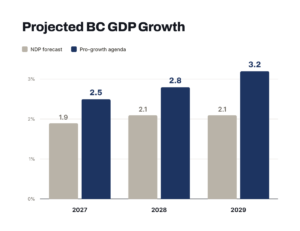
For business: Closer alignment could create opportunities to advance trade projects. Proposals that demonstrate investment, jobs, and provincial revenue would speak directly to the government’s need to fund tax relief and public services through growth.
DRIPA repeal: First Nations partnerships will need a new foundation
Why it matters: The pledge to repeal DRIPA puts the Conservatives’ relationship with First Nations to an early test. For many Nations, the Act represents a commitment to work together on decisions affecting their rights and territories. Repeal could deepen mistrust, particularly without meaningful engagement or a clear plan for future collaboration.
The reality: The government will still need to consult First Nations on decisions that may affect their rights. Strong relationships will remain essential to its broader agenda.
The opportunity: The Conservatives have promised to strengthen consultation capacity and support Indigenous economic participation through ownership and revenue sharing. In practice, that means involving Nations early, ensuring they have the resources to assess proposals, and negotiating agreements that reflect their priorities.
For proponents: Early partnerships with First Nations will remain central to advancing development. For Nations, commitments on ownership, revenue sharing, and consultation capacity provide an opening to shape projects and secure lasting community benefits.
The bottom line: Implementation will affect project timelines and confidence in B.C. as an investment destination.
Broad coalition: A foundation for responsive government
The challenge: The Conservatives brought together voters seeking change for different reasons, and many ridings flipped Conservative by only hundreds of votes. Their tightly coordinated campaign kept the team and message on track. Governing will be harder: ministers will face competing demands, public scrutiny, and less control over messaging.
Why it matters: The Campbell government’s majority in 2001 did not prevent fiscal restraint from drawing criticism for pressure on social programs. The Conservatives now face that fiscal challenge alongside a pledge to repeal SOGI 123, which could divide voters who supported them for other reasons.
The signal: This iteration of the Conservatives appears to recognize what voters want and care about. Doerkson made that responsiveness clear in his victory speech: “I want to say a word to the people who aren’t in this room. There is a place for you here. Bring your ideas, bring your family, bring your ambitions, and somebody will pick up the phone in British Columbia.”
The bottom line: That invitation gives businesses and communities an opening to bring practical ideas to a government shaping its priorities for delivery. Proposals that connect economic growth with affordability, reliable services, and local benefits can speak to the shared interests holding its broad coalition together.